SEO · 2026-11-28
GPT-6.2 vs GPT-6: What Changed for Brands in ChatGPT
Same 223 ChatGPT prompts before and after the Nov 24, 2026 GPT-6.2 switch: questionnaires vanished, calculators rose, brand links increased while citations reshuffled.

On November 24, 2026, ChatGPT switched to GPT-6.2. The interface looked the same. The answers did not.
I care about this for a practical reason. For years, SEO work has been about winning a place in a list of links. AI answers are becoming a place where brands get named, compared, linked, and sometimes quietly dropped, before a buyer ever opens a search result. When the model underneath that surface changes, the visibility map can move overnight.
Prompt Rocket runs the same 223 prompts through ChatGPT every day and saves the full answers. That made a clean before-and-after possible. Below is what changed for brands across the five measured findings from that comparison.
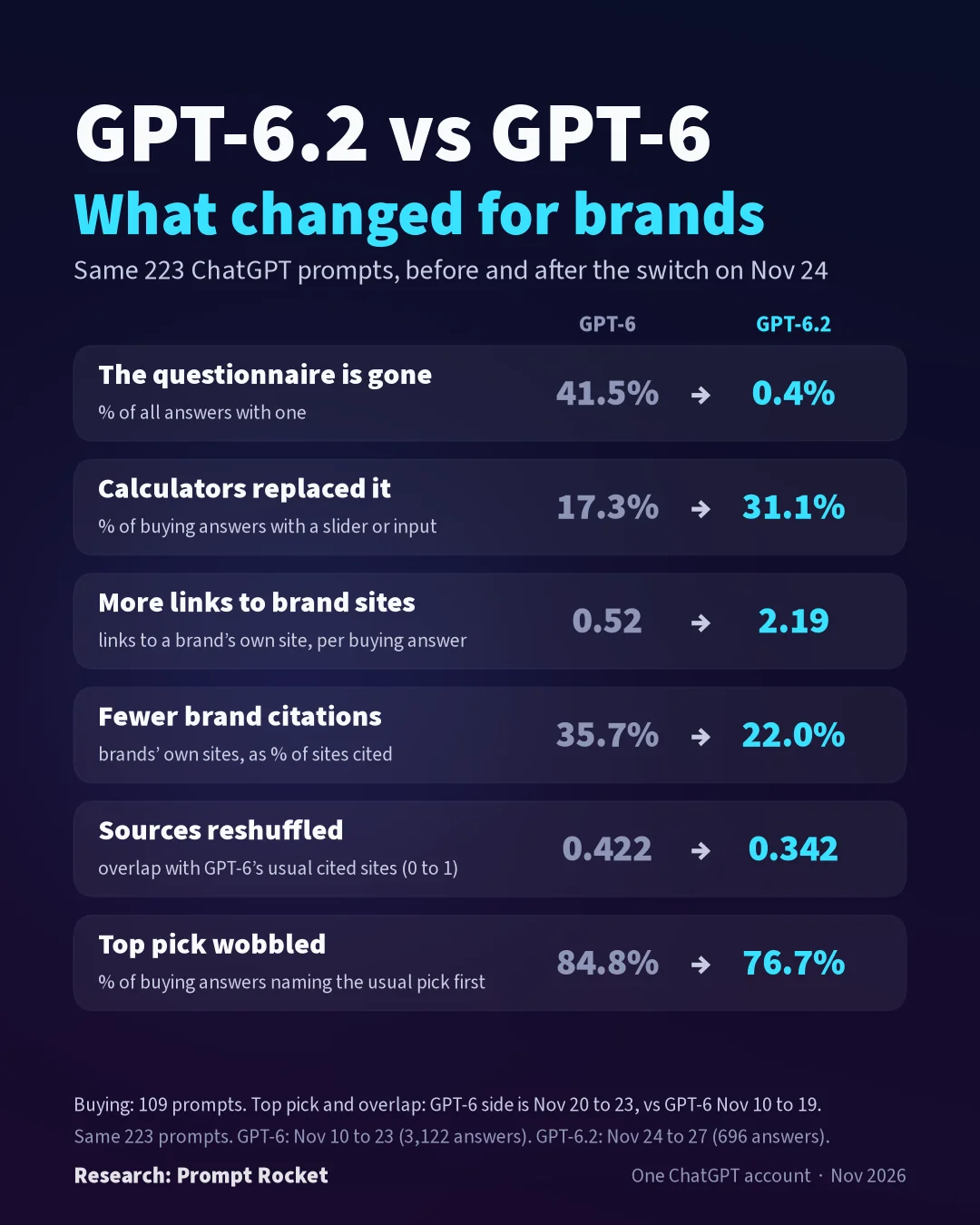
The pattern is simple enough to remember: GPT-6.2 names and links brands more, leans harder on third-party pages as evidence, and a model switch can reset citations within days.
How we compared GPT-6 and GPT-6.2
Everything below uses the same 223 prompts. GPT-6 covers November 10 to 23 (3,122 answers). GPT-6.2 covers November 24 to 27 (696 answers). Of those prompts, 109 are buying-intent prompts.
Where we needed a noise check, we compared two GPT-6 periods against each other: November 10 to 19 versus November 20 to 23. That baseline matters. It shows what a normal week-to-week wobble looks like before you blame, or celebrate, a model update.
One account, one window, one set of prompts. The findings are still sharp enough to act on, as long as you treat them as correlation with a clear timing signal, not as a universal law of ChatGPT.
The questionnaire is gone
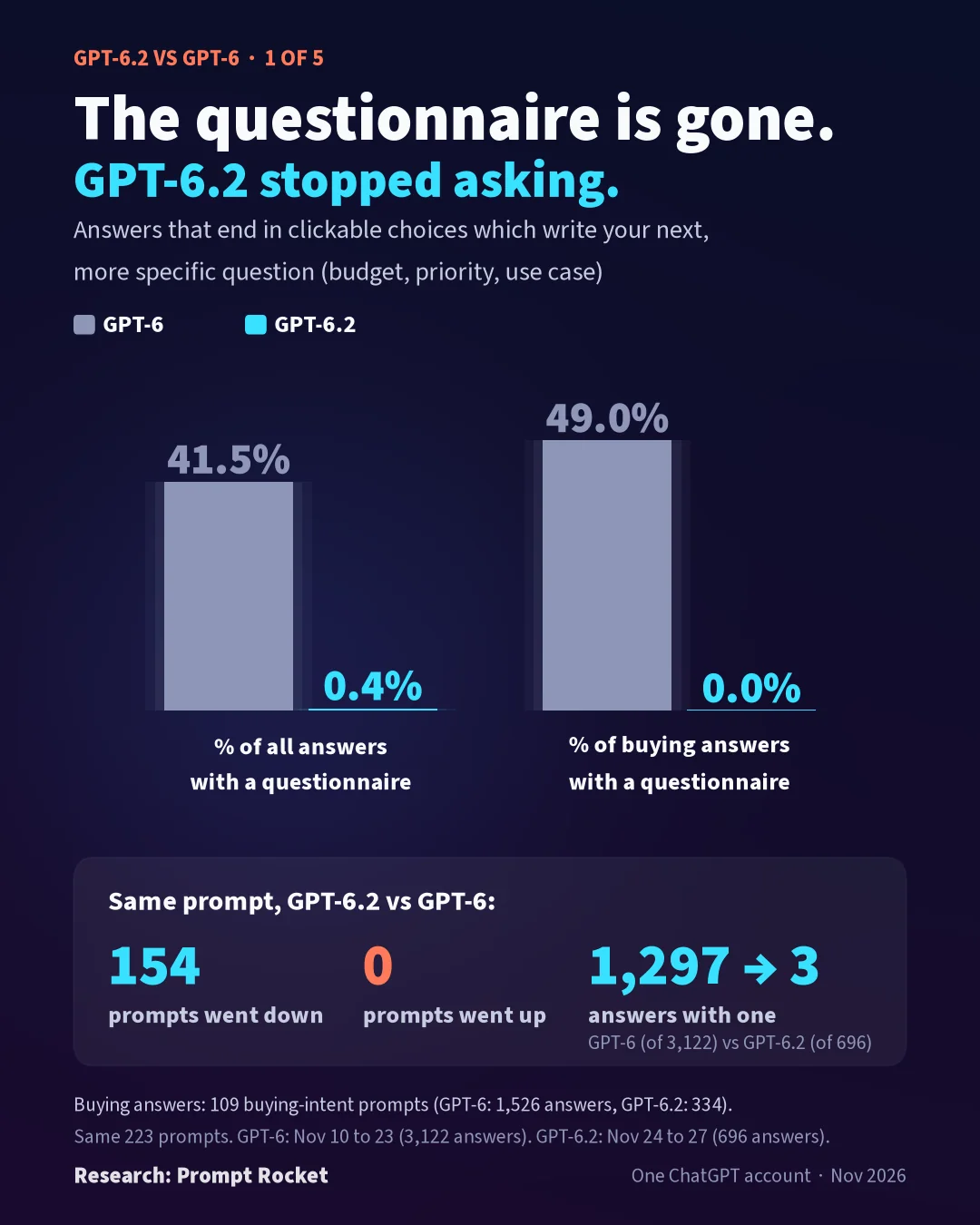
Under GPT-6, 41.5% of all answers came with a built-in questionnaire: the little form that asks about budget, priorities, or situation before narrowing the answer. On buying questions it was 49.0%.
Since GPT-6.2 arrived, that share is 0.4% of all answers (3 of 696) and 0.0% of buying answers. Of the prompts where the rate changed, 154 went down and none went up. A placebo check comparing two GPT-6 periods moved less than one point, so the timing points to the model switch rather than ordinary drift.
That matters because the questionnaire was where ChatGPT gathered context before it named brands. Without it, the first answer has to do all the work. Answers that reference the user's saved memory also rose, from 1.7% to 6.5%, so the model appears to fill gaps from what it already knows instead of asking. If your content assumed a second, narrower question, the first answer is now the one that counts.
Calculators replaced the follow-up
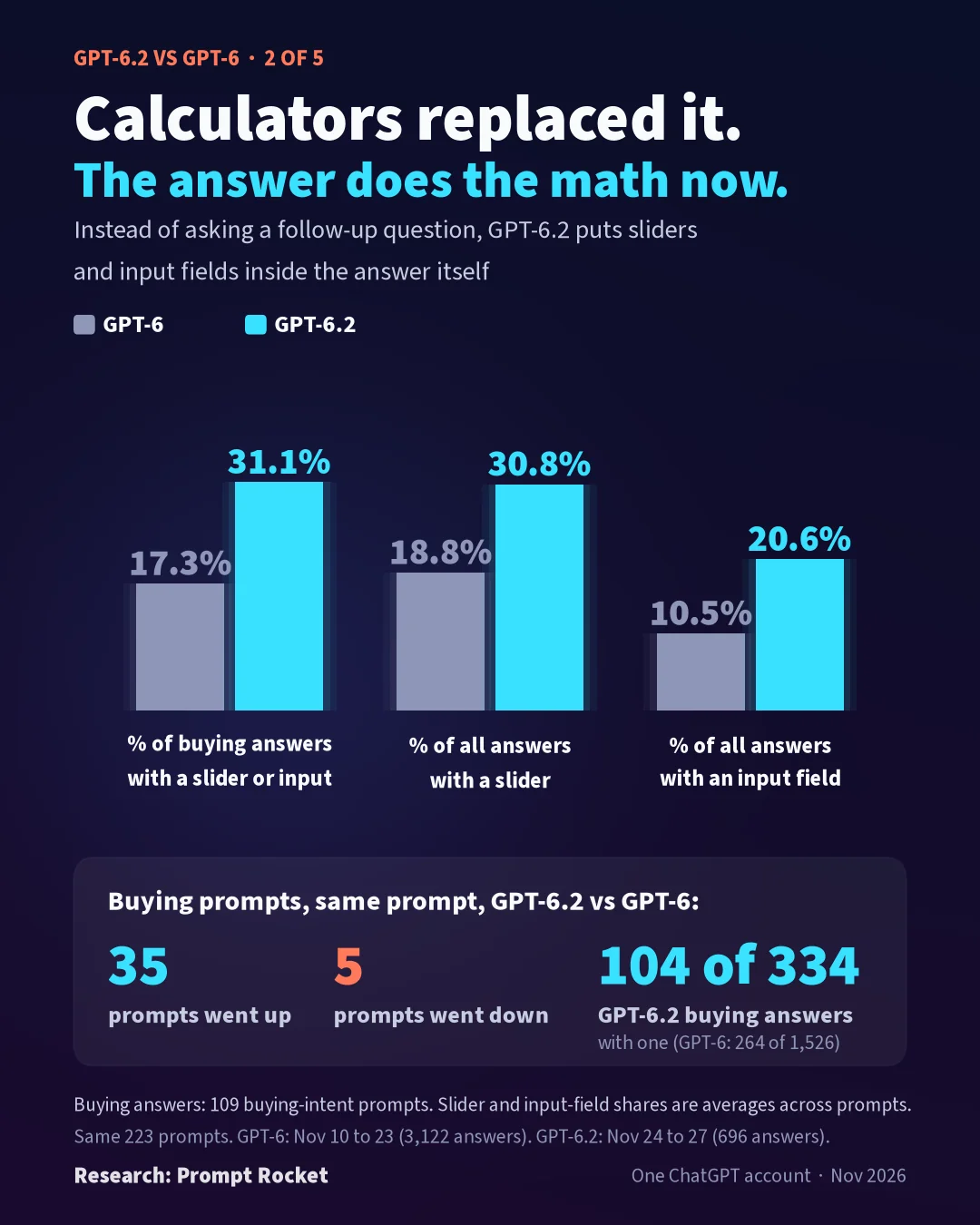
When ChatGPT stopped asking, it started handing out tools.
On buying questions, the share of answers with an interactive slider or input field went from 17.3% under GPT-6 (264 of 1,526 answers) to 31.1% under GPT-6.2 (104 of 334). Across all answers, sliders went from 18.8% to 30.8% and input fields from 10.5% to 20.6%, averaged across prompts. On buying prompts, 35 went up and 5 went down.
The follow-up question did not disappear. It moved inside the answer. Instead of "what is your budget?", the reader drags a budget slider and the comparison updates.
That changes what useful brand content looks like. Pricing, fees, rates, limits, and plan tiers are exactly what these calculators need. If those numbers are hidden behind "contact us," vague ranges, or images of tables, the model has less to work with when it builds the calculator for your category. Clear, current, text-based numbers are becoming a visibility asset.
More links, fewer citations
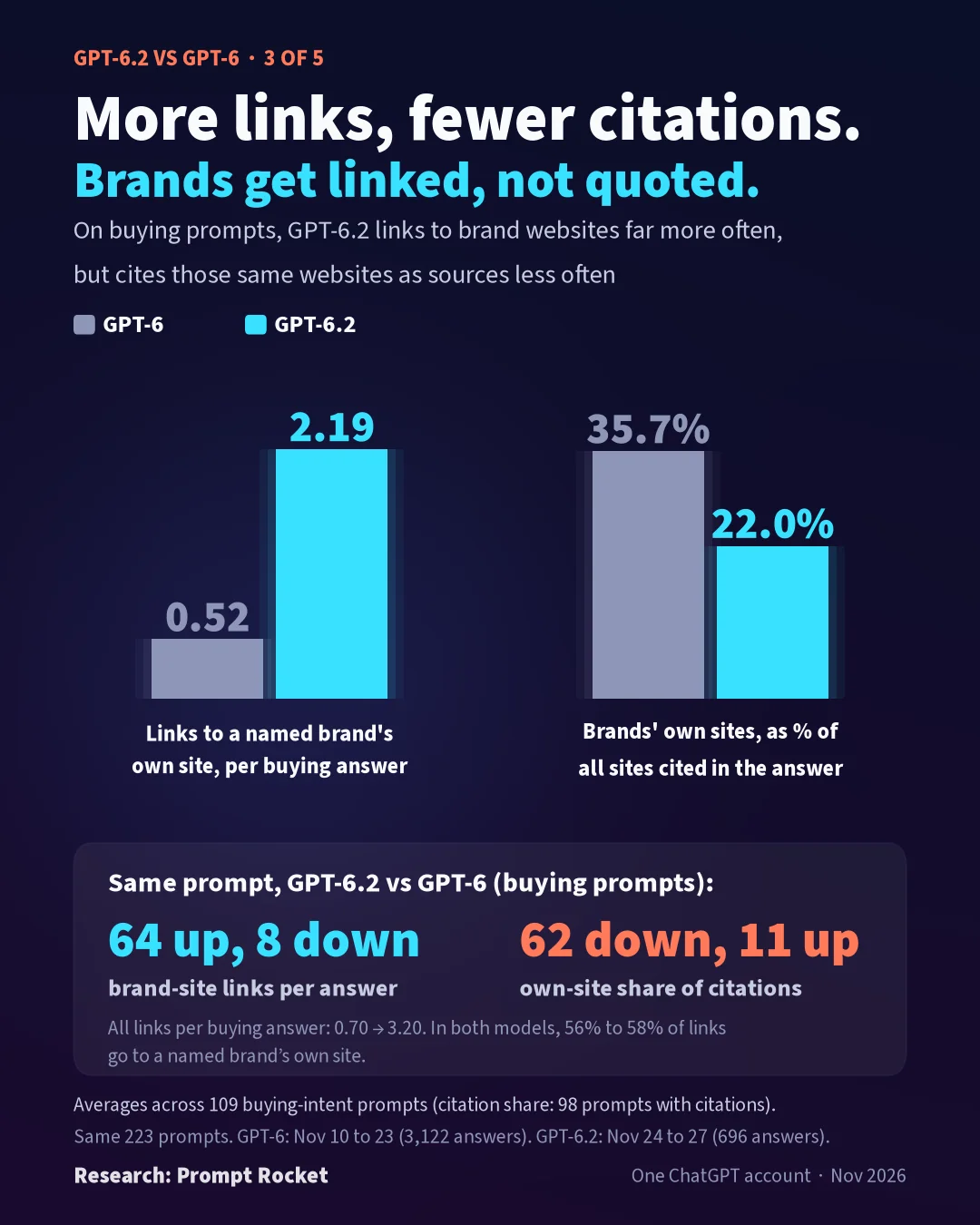
Across the 109 buying prompts, links to a named brand's own website went from 0.52 per answer under GPT-6 to 2.19 under GPT-6.2. That rose on 64 prompts and fell on 8. All links per buying answer went from 0.70 to 3.20, and in both models 56% to 58% of those links pointed to a brand's own site.
Citations moved the other way. Brands' own sites made up 35.7% of the sites cited in buying answers under GPT-6. Under GPT-6.2 it is 22.0%. That fell on 62 prompts and rose on 11.
Put simply: the model now names you and links you, but it prefers someone else's page as the evidence. Reviews, news, and retailer pages carry more of the "why."
Two separate jobs are emerging. Your own site needs to be the obvious destination once you are named. Your reputation on third-party sites is what gets quoted as proof. Measuring only one of them will give you half the picture.
Sources reshuffled
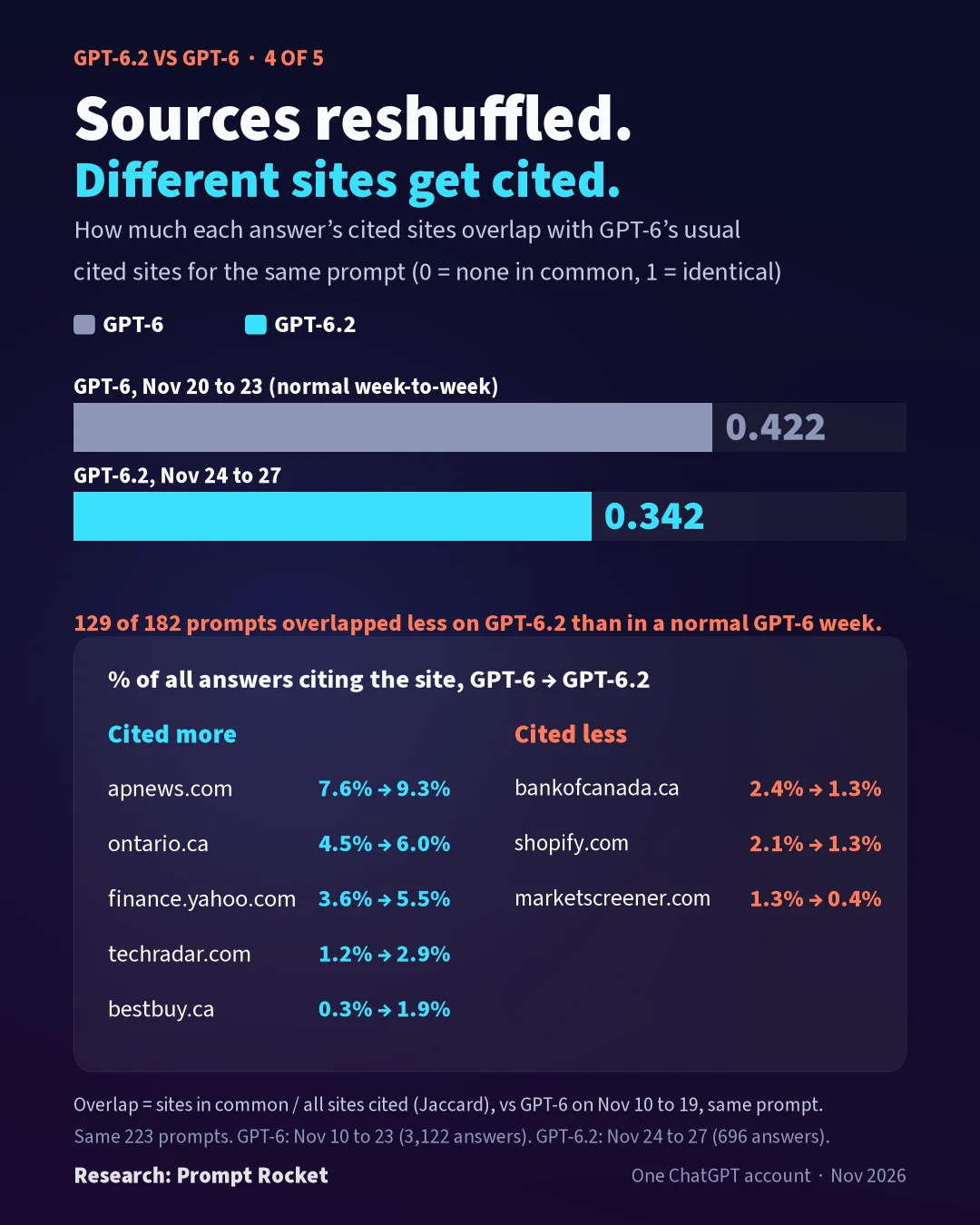
For each of the 223 prompts, Prompt Rocket compared the sites cited in each answer with the sites GPT-6 cited for that same prompt on November 10 to 19. On a 0 to 1 scale, where 1 means identical, GPT-6's own answers on November 20 to 23 scored 0.422. That is the normal week-to-week churn. GPT-6.2 scored 0.342, and 129 of 182 prompts overlapped less than in a normal week.
Some sites gained, measured as a share of all answers citing them: AP News went from 7.6% to 9.3%, Yahoo Finance from 3.6% to 5.5%, TechRadar from 1.2% to 2.9%, and Best Buy Canada from 0.3% to 1.9%. Some lost: Bank of Canada from 2.4% to 1.3%, Shopify from 2.1% to 1.3%, MarketScreener from 1.3% to 0.4%.
The takeaway is not that any one site won. It is that a model change can reset citation patterns in days. If you track AI visibility, mark model switches on your charts. Do not read a sudden drop or jump as something your content caused until you have checked which model answered.
Longer answers, and a wobbling top pick
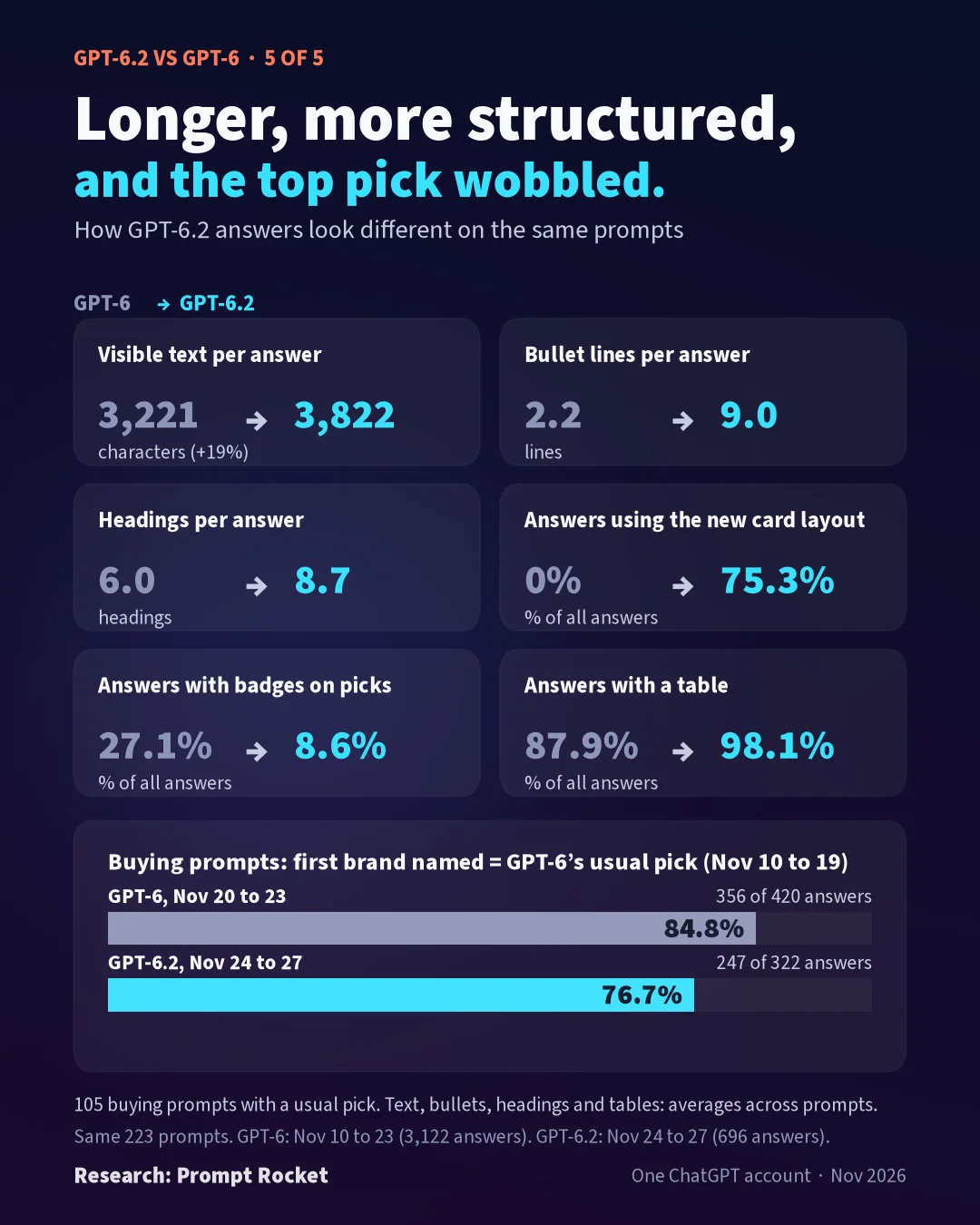
On the same 223 prompts, visible text per answer grew from 3,221 to 3,822 characters, up 19%, and got longer on 203 prompts. Bullet lines went from 2.2 to 9.0 per answer and headings from 6.0 to 8.7. Tables now appear in 98.1% of answers, up from 87.9%. A new card layout shows up in 75.3% of GPT-6.2 answers. Badges on picks dropped from 27.1% of answers to 8.6%.
The part brands will notice: on buying prompts, Prompt Rocket checked whether the first brand named matched GPT-6's usual first pick from November 10 to 19. GPT-6 kept it 84.8% of the time on November 20 to 23 (356 of 420 answers). GPT-6.2 kept it 76.7% of the time (247 of 322). It fell on 30 prompts and rose on 17. Most picks held, but some shifted, for example from Betterment to Wealthfront and from Mailchimp to MailerLite or Brevo.
If you hold the top spot in a category, a model update is a good moment to recheck it rather than assume it.
What marketers should do
None of this asks brands to abandon classic SEO. It asks them to stop treating ChatGPT like a static directory.
- Win the first answer. The questionnaire that used to gather budget and use-case context is effectively gone. Assume the first response is the only response.
- Publish machine-usable numbers. Sliders and inputs need pricing, fees, rates, limits, and plan tiers in plain text, not locked behind sales forms or screenshots.
- Separate link jobs from citation jobs. Own-site pages still need to be the destination. Third-party reviews, news, and retailer pages increasingly carry the evidence.
- Annotate model switches on your AI visibility charts. A citation shuffle after an update is not automatically a content win or loss.
- Recheck category leadership after releases. Most top picks held, but 76.7% is not 84.8%, and a few categories moved.
I have written before about the split between brand presence in the prior and rank in the fetch. This GPT-6.2 window sharpens a third cut: destination versus evidence. Being linked and being quoted are no longer the same event.