Design · 2026-06-16
Your Design File Is Now an API
Design files now feed AI coding tools and agents. Treat Figma context like an API so machines preserve intent instead of guessing.
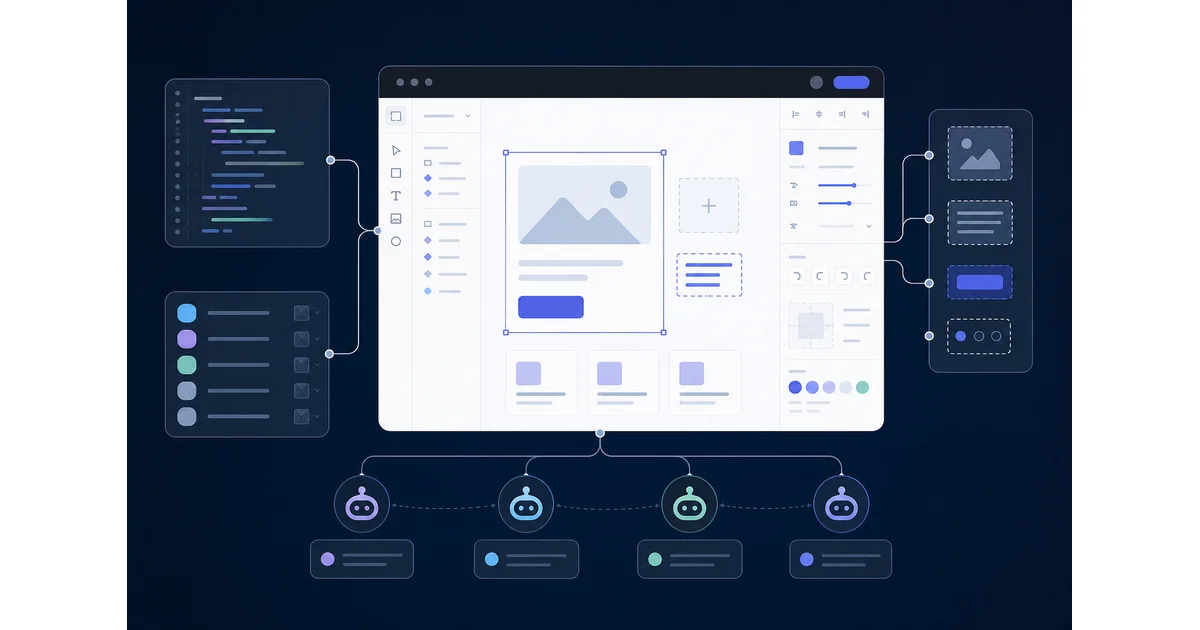
For a long time, a design file could be a beautiful sketch with a few unspoken agreements hiding inside it.
You could leave a state implied. You could name a frame “final-final-v3” and trust that everyone knew what it meant. You could rely on a Slack thread, a hallway conversation, or a quick call with engineering to carry the intent that never made it into the file.
That bargain is collapsing.
I have been in enough product conversations to know the cost of ambiguity. It rarely shows up as one dramatic failure. It shows up as small translation errors: the wrong empty state, the missing hover rule, the button that looks right but behaves wrong, the component that gets rebuilt because nobody knew it already existed.
In an agentic workflow, those errors get more expensive. The file is no longer just a picture for humans. It is becoming structured context for developers, AI coding tools, design systems, and agents. A messy file now costs you twice: once when people misread it, and again when machines automate the misreading.
Handoff was a human protocol
Handoff was never really about exporting assets. It was a human protocol.
A designer made a mockup. A developer interpreted it. A product manager clarified edge cases. Someone filled in the gaps. If the team was strong, that worked reasonably well because humans are good at inference. We can read between the lines. We can ask, “Did you mean this?” We can notice when a detail feels wrong even if the file is silent.
AI tools do not work that way. They do not share the team’s memory. They do not know which component is canonical, which experiment was abandoned, or which weird-looking constraint exists because of a real customer problem. If the context is not in the system, the tool guesses.
And guessing is not design.
The file has a new audience
The important shift is that design files now have two audiences: people and machines.
People need clarity, taste, and intent. Machines need structure, names, states, relationships, constraints, and source-of-truth signals. Good files increasingly need to serve both.
This is why the conversation around design context matters. Anthropic introduced the Model Context Protocol to help AI systems connect to external tools and data. OpenAI talks about agents as systems that use tools, knowledge, and workflows. Figma is moving design context closer to developer and agent workflows. The direction is clear: software is learning to ask source systems for context instead of waiting for a static handoff.
Your design file is not merely a picture of the product. It is becoming part of the product’s memory.
That does not mean every designer needs to become an engineer. It does mean designers need to treat structure as part of the craft.
The four layers of usable design context
If a design file is going to function like an API, it needs to expose useful context. Not everything. Not bureaucracy for its own sake. Just the information required for humans and tools to preserve intent.
- Semantics. Names that explain what something is, not just what it looks like. “Primary checkout action” is more useful than “blue button.”
- System links. Components, variables, tokens, and patterns tied back to the design system instead of floating as one-off objects.
- States and edge cases. Loading, error, empty, disabled, success, mobile, long text, permission limits, and failure paths.
- Constraints and intent. The reason a choice exists, especially when it is not visually obvious.
The last layer is the one teams skip most often. It is also the layer that keeps machines from confidently doing the wrong thing.
A frame can show that a modal exists. It may not explain that the modal is intentionally hard to dismiss because the action is destructive. A button can show a colour. It may not explain that the colour is reserved for irreversible actions. A dashboard can show a chart. It may not explain which metric actually matters.
That hidden reasoning is the difference between copying pixels and preserving product judgment.
Ambiguity now compounds
When humans misunderstand a design file, the damage is usually local. A developer asks a question. A designer clarifies. The team loses some time.
When an AI tool misunderstands a file, the damage can scale quickly. It can generate a component with the wrong assumption, repeat that pattern across screens, and make the output look coherent enough that nobody notices the drift until later.
This is the strange danger of AI-assisted product work: the wrong answer can look very complete.
That is why file hygiene is no longer just professionalism. It is leverage. Clean naming, real components, documented states, and clear constraints make the next human faster. They also make the next machine less likely to invent missing context.
How to structure a design file like an API
The goal is not to make design sterile. The goal is to make intent portable.
- Name frames by user flow and state, not by version anxiety.
- Use components when something is meant to repeat.
- Document variants where behaviour changes, not just where visuals change.
- Keep abandoned ideas separate from canonical flows.
- Attach notes to decisions that are easy to misread.
- Show edge cases before someone has to ask for them.
- Make design-system connections obvious.
None of this is glamorous. That is partly the point. Infrastructure rarely feels glamorous while you are building it. It feels useful later, when everything else moves faster because the foundation is clean.
The teams that benefit most from AI will not be the teams with the messiest process and the best prompts. They will be the teams whose source material is legible enough for tools to use without destroying the meaning.
Do not let machine readability kill craft
There is a risk in this argument. Taken too far, it becomes a demand for lifeless, over-documented files where every creative decision is flattened into a checklist.
That is not the goal.
The best design files should still feel human. They should still carry taste, pacing, hierarchy, restraint, and surprise. A great product is not assembled only from tokens and constraints. It is shaped by judgment.
But judgment that cannot survive handoff is fragile. Judgment that can be named, structured, and connected becomes durable.
Clean files are leverage
A design file used to be the place where the product was imagined. Increasingly, it is also one of the places where the product is explained to machines.
That changes the standard. A beautiful but ambiguous file is not enough. A tidy but thoughtless file is not enough either. The file has to carry intent.
This is the new craft: not just making the interface look right, but making the reasoning behind it usable by the systems that will help build it.
Your design file is now an API. Treat it like one. The team that wins will not simply have the prettiest mockups. It will have the clearest intent, and that intent will survive the trip from idea to interface to code.