Work · 2026-06-16
Source First: How to Write With AI Without Outsourcing Your Brain
A source-first AI writing workflow that keeps evidence, judgment, and synthesis in your hands instead of outsourcing your thinking to the machine.
Most people do not outsource their brain to AI in one dramatic decision. They do it one smooth paragraph at a time.
I understand the temptation. For much of my career, the work has been taking messy signals and turning them into a decision: search data, customer behaviour, market noise, product constraints, competitor pages, half-finished strategy documents. The job is rarely just “write something.” The real job is figuring out what is true enough to act on, then explaining it clearly enough that other people can act too.
AI makes that process faster. It does not remove the responsibility.
The danger with AI writing is not only hallucination. Hallucination is obvious enough that careful people know to check for it. The quieter danger is premature closure: the feeling that the work is basically done because the model produced something fluent. It has the shape of thinking. It has the rhythm of an argument. It has confidence. But confidence is not the same thing as conviction.
Source-first writing means the evidence enters the room before the model starts performing intelligence.
The real failure mode is premature closure
A blank page is uncomfortable because it asks you what you actually think. AI removes that discomfort almost instantly. Ask for a summary and you get one. Ask for a draft and you get one. Ask for three smart takes and it will manufacture the outline of intelligence on command.
That can be useful. It can also be anesthetic.
Microsoft Research’s 2025 work on generative AI and critical thinking points at something many knowledge workers already feel: the more confidence people place in AI, the easier it becomes to reduce their own critical effort. Atlassian has reported that knowledge workers lose a large amount of time simply searching for answers. Asana has spent years naming the other tax: work about work. AI can help with both problems. But if you put it in the wrong place, it does not just reduce friction. It reduces the part of the friction that was forcing you to think.
That is the trade. AI can save you from drudgery, or it can save you from judgment. Only one of those is a good bargain.
Put the sources in the room first
The best AI writing workflow does not begin with a prompt. It begins with sources.
That might mean research papers, transcripts, notes, interviews, search data, product docs, financial filings, customer conversations, or the raw mess of your own observations. If I am working from market interest, I would rather start with a real signal from a tool like DailySearchVolume.com than ask a model to invent what people care about. The source gives the work gravity. The model helps move the furniture.
This is why tools like Google NotebookLM are interesting. The point is not that they make AI magical. The point is that they change the posture. Instead of asking the model to know everything, you give it a defined evidence room and ask it to help you navigate that room.
That is the right relationship.
A five-stage source-first workflow
The workflow is simple, but it requires discipline. The discipline is not technical. It is editorial.
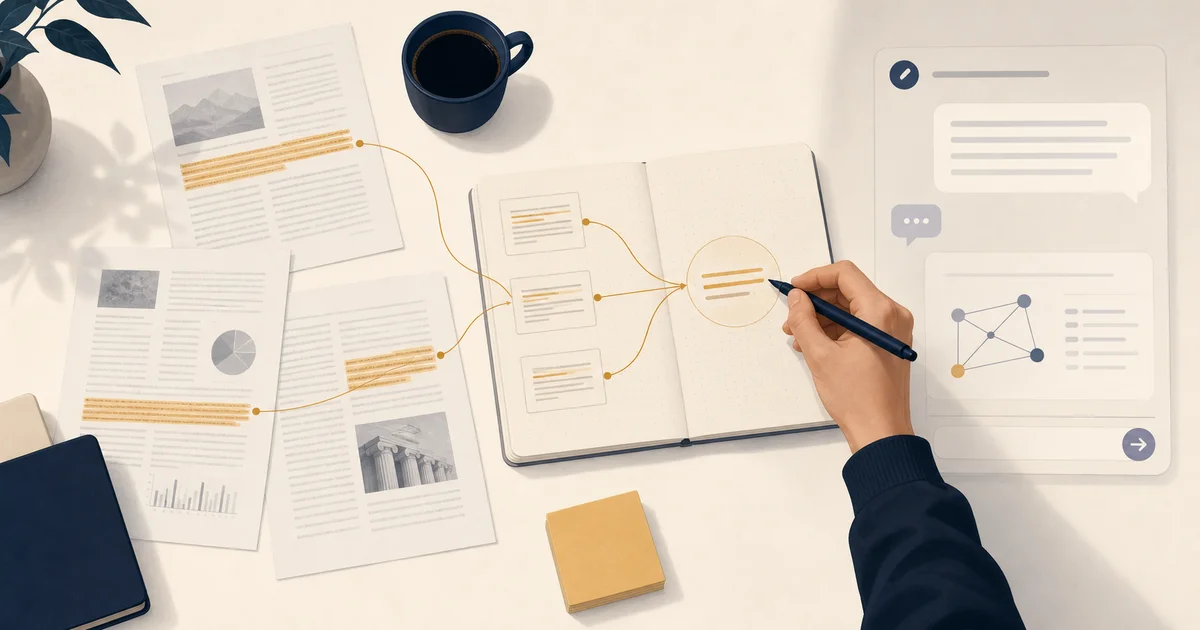
- Collect. Gather the source material before drafting. Do not start by asking AI for an article. Start by building the evidence pile.
- Annotate. Mark the passages, numbers, tensions, and examples that actually matter. Your highlights are the first layer of judgment.
- Interrogate. Use AI to extract claims, compare sources, identify contradictions, and surface missing questions. Make it earn its place as a research assistant.
- Synthesize. Write the central thesis yourself. This is the point where the piece becomes yours or becomes generic.
- Publish. Let AI help with structure, clarity, alternate phrasing, and claim checks, but keep the final argument in human hands.
The key is sequence. If AI drafts before you have a thesis, it will quietly supply one. If AI summarizes before you have read enough to care, it will decide what matters. If AI smooths the prose before the argument has a spine, it will make weak thinking more pleasant to read.
That is not progress. That is varnish.
What AI should do
AI is excellent at certain jobs. It can cluster notes. It can find repeated themes. It can compare two documents. It can turn a messy transcript into a usable outline. It can ask annoying questions that reveal gaps. It can produce ten alternate titles when your brain is tired.
Use it for that.
Make it the analyst, the librarian, the devil’s advocate, the copy editor, the formatter, the second pair of eyes. Let it help you move through information faster than you could alone.
But do not let it decide what you believe.
The claim, the frame, the moral weight of the argument, the final call on what belongs and what does not — those are not chores to automate. They are the work. They are the reason the piece should exist with your name on it.
The traps are subtle
The first trap is easy summaries. A summary feels productive because it reduces complexity. But sometimes complexity is the point. The tension between sources is often where the insight lives.
The second trap is citation cosplay. A piece can contain source names, links, and academic-looking references while still being intellectually hollow. Sources are not decorations. They should constrain the argument.
The third trap is voice flattening. AI tends to sand down the weird edges, the personal observations, the small acts of taste that make writing feel human. It will often make a sentence more polished and less alive at the same time.
The fourth trap is borrowed certainty. The model can make a weak position sound settled. Be careful with that. Strong writing does not require pretending to know more than you know. It requires being honest about what the evidence supports and clear about the judgment you are making.
Keep the verdict human
A good piece of writing is not just information arranged in order. It is a verdict. It says: after looking at the evidence, this is what I think matters.
That verdict can be modest. It can be provisional. It can leave room for disagreement. But it has to be yours.
This is where AI should make us more demanding, not less. If the machine can produce competent prose in seconds, then competent prose is no longer the bar. The bar moves to judgment, taste, source discipline, and the courage to say something specific.
I am not interested in purity tests around AI. Avoiding the tool completely feels sentimental and unrealistic. But handing over the thinking is just as lazy in the opposite direction.
The better path is source first. Evidence first. Judgment first. Then assistance.
Let the machine carry the paperwork. Do not let it carry the conviction.