Work · 2026-06-16
Your Personal Website Is a Control Surface, Not a Brochure
Why your personal website is no longer a brochure, but the control surface for your ideas, projects, attribution, and AI-era discovery.
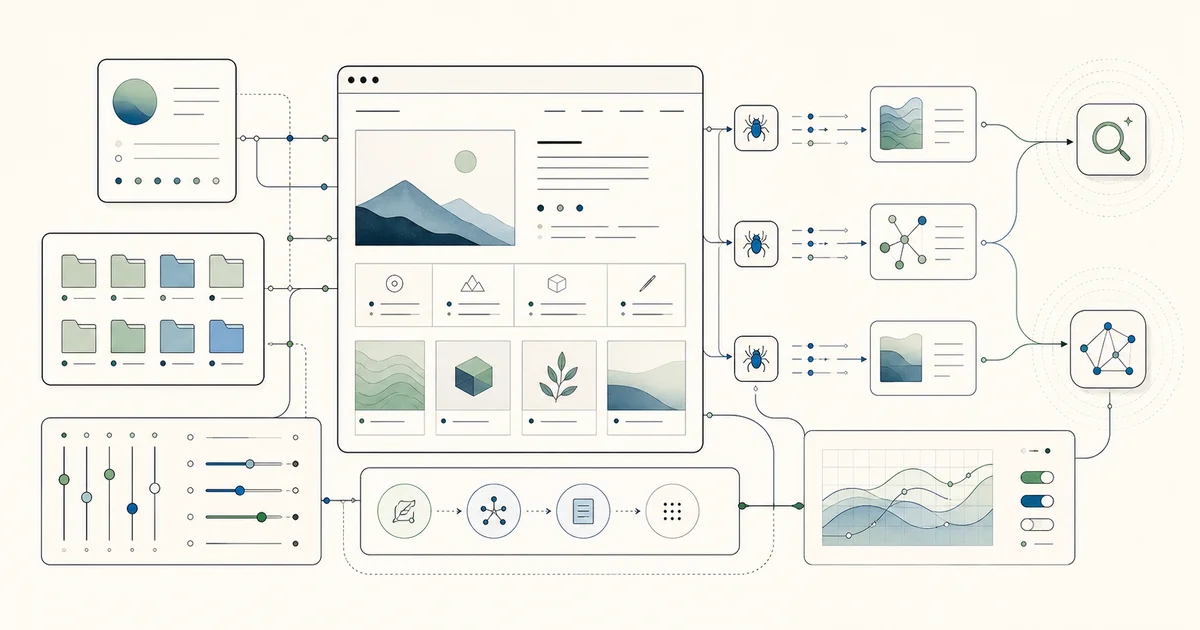
A personal website used to be easy to misunderstand. It looked like a brochure: a polite little page that said who you were, what you had done, and how someone could contact you.
I do not think that way anymore.
If you have worked in search long enough, you start to see a simple pattern. Distribution changes. Platforms rise and fall. Feeds get noisy. Algorithms change their appetites. But clean, canonical sources age better than almost everything else.
That is what a personal website is now. Not a brochure. A control surface.
It is the place where your ideas become indexable, your projects become legible, your professional record becomes canonical, and your work has a chance to be cited correctly by humans and machines. It is one of the few parts of the internet where you are not merely renting space in someone else’s interface.
The old bargain broke
The old web bargain was simple: publish on platforms because that is where the attention is. Twitter, LinkedIn, Medium, Substack, YouTube, TikTok, whatever the current distribution machine happens to be. There is nothing wrong with using those channels. I use rented attention all the time. Most people should.
But rented distribution has a ceiling. It gives you reach without much control. Your work appears in a feed, gets a small window of attention, then disappears into the platform’s memory hole. The platform remembers the engagement. You may not get much durable equity from it.
AI makes this more obvious. A user may never visit the original page. A system may summarize your work, cite it, misread it, or ignore it. Discovery is being abstracted by another layer.
A lot of people see that and conclude the personal site is less important. I think that is backwards. The more discovery is mediated, the more important it becomes to own the source material.
Machines read before people do
Google’s guidance around AI features is more boring than most hot takes, which is usually a sign that it matters. The basics still count: make pages crawlable, indexable, clear, and useful. Cloudflare’s recent work around AI crawler control and Pay Per Crawl points in the same direction from the infrastructure side. Access to content is becoming a surface that can be allowed, blocked, priced, or measured.
That is the new environment. Your site is not just for visitors who type in your URL. It is for search engines, AI systems, linkers, journalists, collaborators, employers, clients, and future versions of yourself trying to remember what you actually thought.
If your best work only lives inside closed feeds, screenshots, private docs, or scattered social posts, you are making every discovery system guess.
A personal site reduces the guessing.
What a control surface controls
A good personal website does not need to be complicated. It needs to control the right things.
- Identity. Who are you, what do you do, and what should people trust you on?
- Archive. Where do your durable ideas live after the feed forgets them?
- Projects. What have you actually built, shipped, led, or maintained?
- Attribution. When your work is referenced, what is the canonical page?
- Conversion. What should an interested person do next?
- Measurement. What topics, pages, and projects are attracting real demand?
This is one reason I like having a site that connects essays, a resume, and projects in one place. DailySearchVolume.com, PortfolioAI.com, TheBallparkGuide.com, and StockApp are not just names on a list. They are evidence. They say something about what I build, how I think, and where my attention has gone over time.
A feed can mention those things. A personal site can organize them.
The site does not need to perform
There is a trap here. Once people decide their personal site matters, they often turn it into a branding project. They redesign the homepage seven times, argue with themselves about fonts, and write an about page that sounds like it was assembled by a committee of motivational posters.
That is not the point.
The point is clarity. A personal website should answer a few basic questions quickly: What do you know? What have you done? What do you believe? What are you building? How can someone go deeper?
The best personal sites are often less polished than corporate sites and more useful. They have a point of view. They have archives. They have project pages. They have signs of life. They make it easy to understand the person behind the work.
That matters because trust is increasingly assembled from fragments. Someone sees a post, searches your name, reads an essay, checks a project, lands on your resume, then decides whether you are worth their time. Your site is the surface where those fragments become a coherent picture.
A simple personal-site audit
If you already have a site, the audit is straightforward.
- Can a stranger understand your professional identity in under ten seconds?
- Do your best ideas have permanent URLs?
- Are your projects explained as outcomes, not just logos?
- Is there a canonical resume or about page?
- Are titles and descriptions written for humans, search engines, and AI summaries?
- Can someone contact you or take the next step without hunting?
- Would an AI system have enough clean context to summarize you accurately?
If the answer is no, the fix is not necessarily a redesign. It may be three better pages: a clear about page, a serious project page, and a small archive of essays that show how you think.
That is enough to start compounding.
Rent distribution, own the asset
I am not arguing for a retreat from platforms. Attention still moves through them. You should use the feed, the newsletter, the podcast, the social network, the search result, the AI answer, whatever helps the work travel.
But distribution is not the same thing as ownership.
Your personal website is where the work comes home. It is where the scattered signals become a body of work. It is where a passing mention turns into a durable path. It is where a machine can find the source instead of guessing from fragments.
A brochure asks people to admire you. A control surface helps them understand you, cite you, trust you, and take the next step.
In a web increasingly read by machines before humans, that difference matters.