Work · 2026-06-16
Build a One-Person Operating System That Kills Work About Work
A practical one-person operating system for reducing busywork, routing information, making decisions, and shipping work with less friction.
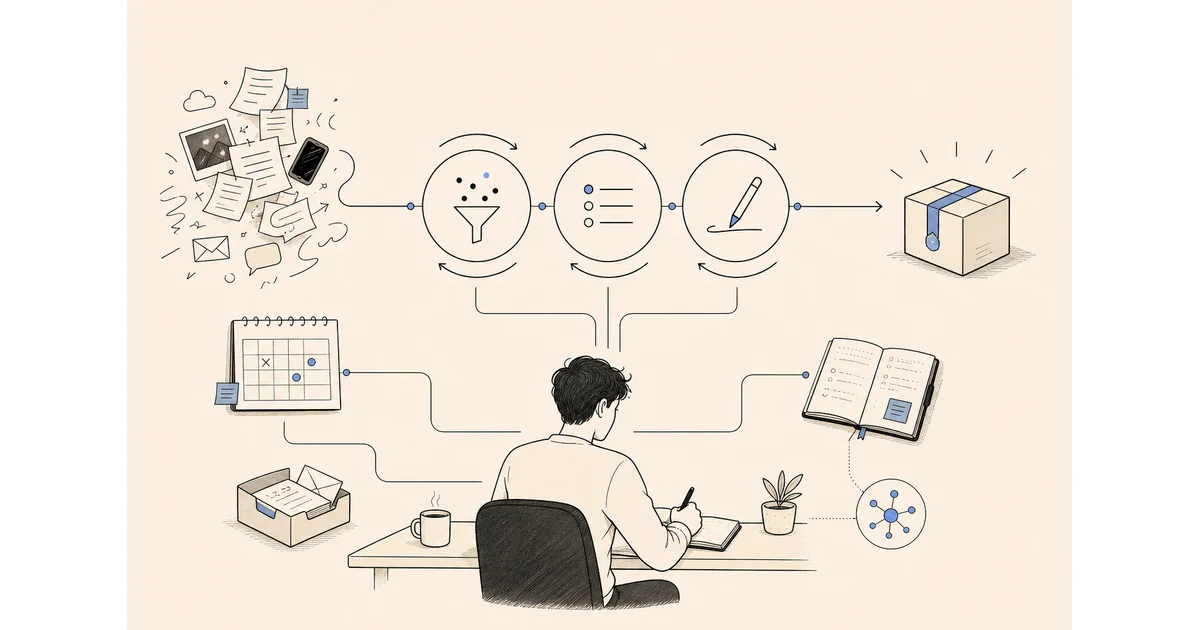
A lot of productive people are not short on discipline. They are drowning in unresolved decisions.
I have seen this pattern in teams, and I have felt it myself. The calendar fills up. The inbox becomes a second job. A useful thought gets trapped in a chat thread. A commitment lives in someone’s memory. A project has three documents, two owners, and no clear next action. Everyone is busy, but the work feels strangely weightless.
That is usually not a motivation problem. It is a system problem.
Modern knowledge work creates endless little pieces of coordination. Some of them are necessary. Many of them are just friction wearing a professional costume. Asana has called this “work about work,” and its research has put the number at a painful share of the workweek. Atlassian’s 2025 State of Teams work says people lose about a quarter of their time searching for answers. Microsoft’s 2025 Work Trend Index points toward a future of human-agent teams.
All of that sounds impressive until you realize a simple truth: AI agents do not fix a messy operating model. They accelerate it.
Busy is not the same thing as directed
Busy has a way of impersonating progress. It gives you motion, notifications, meetings, updates, drafts, reactions, and the satisfying exhaustion of having done many things.
But directed work feels different. Directed work has a line running through it. You know what matters. You know where information goes. You know when decisions get made. You know what “done” means. You know which things deserve attention and which things are just noise asking for respect.
The goal of a one-person operating system is not to become a productivity monk. It is to reduce ambiguity.
A personal operating system is a small set of rules for capturing inputs, making decisions, and shipping work.
That is it. Not a life philosophy. Not a colour-coded shrine to self-improvement. A practical machine for keeping work from leaking all over your day.
The three loops: capture, decide, ship
The system only needs three loops.
1. Capture
Everything that matters needs a trusted place to land. Ideas, obligations, links, notes, meeting follow-ups, article fragments, product thoughts, personal admin, reminders, questions for later. If it matters and it stays in your head, it becomes background anxiety.
Capture does not mean organize perfectly. It means stop losing things. The first rule is simple: there should be one inbox for your own raw inputs. Not twelve. One.
Email can still exist. Slack or messages can still exist. Notes can still exist. But your commitments need one place where they are converted into reality. Until that happens, they are not tasks. They are ghosts.
2. Decide
Most systems fail because they capture but never decide. They become museums of possible work.
Decision is where you ask: Is this real? Is it mine? Is it now? What is the next visible action? What would make this done? If the answer is unclear, the task is not ready. It needs thinking before execution.
This is where AI can help, but only if you remain the judge. It can summarize a messy thread, extract action items, draft a project brief, or turn a rambling note into options. Good. Use it. But do not let the machine quietly turn every possible action into an obligation.
A system should protect your attention, not create more claims on it.
3. Ship
Work has to leave the building. That is the loop people avoid because shipping creates reality. A draft can be judged. A decision can be wrong. A product can fail. A published page can be ignored.
But without a shipping loop, the system becomes self-storage for ambition.
Every week should have a small number of things that are meant to ship: a published article, a fixed bug, a sent proposal, a cleaned-up landing page, a decision memo, a project milestone, a hard conversation. Not just progress. Output.
Rules beat tools
The tool stack matters less than the routing rules. A bad system in beautiful software is still a bad system.
- Inbox. Collect raw inputs, then empty them into decisions.
- Calendar. Reserve time for commitments, not vague aspirations.
- Task list. Hold visible next actions, not emotional reminders.
- Notes. Store thinking, references, and reusable context.
- AI. Reduce friction, summarize context, draft options, and challenge weak thinking.
The important part is that each tool has a job. When every tool can do everything, every tool becomes another place to lose the plot.
I like boring systems because boring systems survive contact with actual work. If your operating system requires ideal behaviour, it is not a system. It is a fantasy.
The weekly review is the steering wheel
A one-person operating system needs a weekly review, but not the kind that turns into ceremonial admin. The point is not to admire your task list. The point is to steer.
Ask five questions:
- What shipped last week?
- What did I avoid deciding?
- What is taking attention without earning it?
- What are the three outcomes that matter this week?
- What can be deleted, delegated, delayed, or automated?
That review is where the system learns. Without it, you are just collecting inputs and hoping momentum becomes strategy.
Signs your system is broken
You do not need a consultant to know when the system is failing. The symptoms are obvious.
- You keep rereading the same messages to remember what you owe people.
- You have many lists but no confidence in any of them.
- You spend more time preparing to work than working.
- You use AI to create drafts you never finish.
- You feel busy all week but struggle to name what shipped.
- Your calendar reflects other people’s priorities more than your own.
When that happens, do not add another app. Tighten the loops. Capture less vaguely. Decide more honestly. Ship more visibly.
The point is fewer leaks
Productivity is often sold as a way to do more. That is sometimes useful, but it is not the deeper value.
The deeper value is having fewer leaks. Fewer open loops. Fewer forgotten commitments. Fewer fake priorities. Fewer half-decisions quietly taxing your attention. Fewer places where good ideas go to become digital sediment.
A one-person operating system gives you back the thing knowledge work keeps trying to take: a clean line of attention.
AI can help. Better tools can help. Templates can help. But the real leverage is the operating model underneath them.
Capture what matters. Decide what it means. Ship what deserves to exist.
The best system is not the one that makes you look busy. It is the one that makes your work leave the building.