Design · 2026-06-16
Build a Taste System Before AI Builds One for You
AI makes speed cheap. Build a taste system with references, constraints, anti-patterns, and decision rules before models flatten your work.
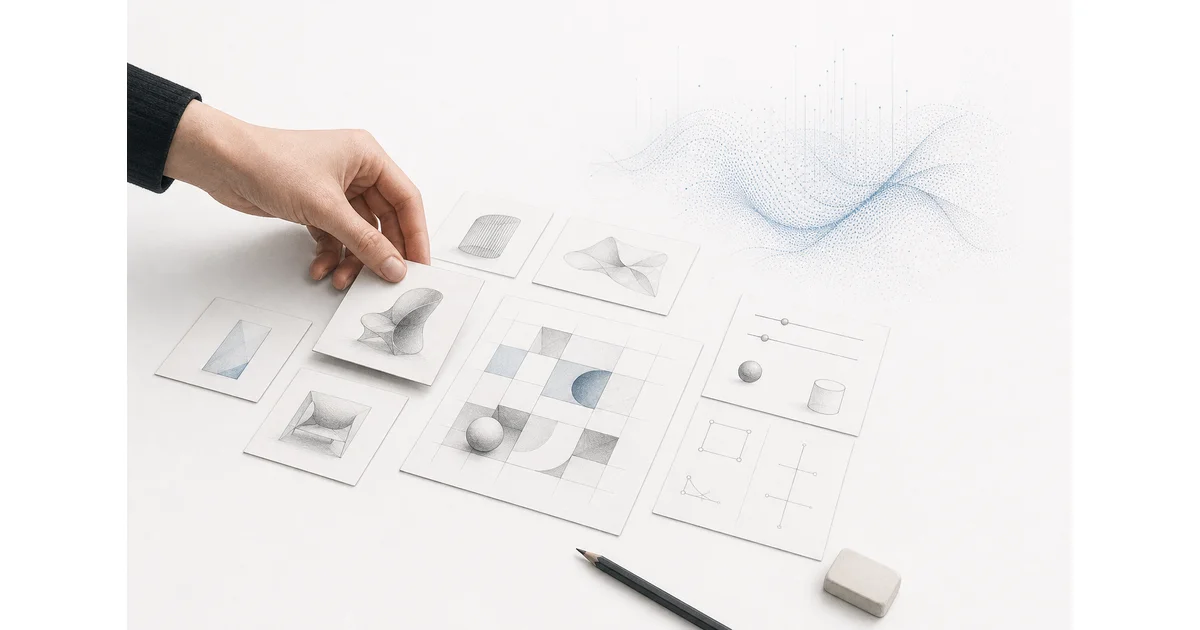
AI is getting very good at producing work that looks finished. It is still remarkably bad at knowing what you should have made.
That gap matters more than most creatives want to admit. For years, taste lived in the foggy part of the job description. A good designer had it. A strong brand had it. A product that felt inevitable had it. But when someone asked us to explain exactly why one direction was right and another was wrong, the room often retreated into safer words: clean, premium, modern, elevated.
Those words are not useless. They are just not enough for machines.
I have spent much of my professional life trying to turn vague signals into useful systems. In SEO, that means taking something as messy as human attention and finding the data underneath it. I have written before that attention routes money. Taste is one of the quiet forces that routes attention in the first place.
The uncomfortable truth is simple: if you do not build a taste system, AI will build one for you out of averages.
Taste is not a moodboard
A moodboard is a room full of influences. Taste is the door policy.
It decides what gets in, what stays out, and what does not belong even if it is fashionable. That distinction matters because AI can imitate a mood very easily. It can make something that looks like a startup landing page, a luxury brand, a fintech dashboard, or a minimalist editorial site. What it cannot reliably infer is your standard.
Taste is the ability to say: this belongs, this does not, and here is why.
Style says what something looks like. Taste says what it is allowed to become. Judgment says when to break the rule. A system makes those decisions reusable.
AI makes hidden judgment visible
When a model gives you fifty plausible options in ten seconds, the bottleneck is no longer production. The bottleneck is selection.
That sounds like a luxury until you are staring at a wall of competent mediocrity. Every option is fine. None are obviously broken. The typography is acceptable. The colours are balanced. The hero section looks like it could have been pulled from a hundred respectable products. And somehow the whole thing has no soul.
This is where a lot of AI-assisted creative work fails. Not because the model is dumb, but because the human has not made the standard explicit. The machine is asked to generate, but nobody has written down what good means.
The market is already pointing in this direction. Figma has been reframing design systems as infrastructure for scaling taste and craft. Apple treats generative AI as a human-interface problem, not only a technical feature. Canva is building toward a broader creative operating system. Different companies, same signal: creative judgment is becoming operational context.
What a taste system contains
A taste system does not need to be a fifty-page brand book. In fact, it is probably better if it starts smaller and sharper.
- References. A tight library of work you actually admire, with notes on what earns its place.
- Principles. The values that should survive across formats, tools, and trends.
- Constraints. Colours, type, spacing, tone, density, motion, and interaction rules.
- Anti-patterns. The things you refuse to do, even when they are popular.
- Examples of finished. Real work that shows the standard at its best.
- Decision rules. Simple tests for choosing between two plausible directions.
The anti-patterns are especially important. Most teams have some idea of what they like. Fewer have the discipline to name what they do not want to become.
Do you avoid fake urgency? Do you hate over-rounded SaaS cards? Is your brand allowed to be playful, or should it feel restrained? Are gradients part of the language or a lazy decoration? Should photography feel documentary or cinematic? Does your product speak like a calm expert or an excited assistant?
These are not cosmetic questions. They are judgment questions. Once they are written down, AI has something to respect.
The prompt is not the system
A lot of people think AI taste begins and ends with prompt writing. That is backwards. A prompt is only the request. The system is the accumulated judgment behind the request.
There is a big difference between asking, “Make this look premium,” and saying, “Design this with a restrained editorial layout, generous white space, quiet typography, no cartoon gradients, no fake social proof, and a tone that feels like a serious operator explaining something useful.”
The second prompt works better because it carries taste. It gives the model boundaries. It turns instinct into instruction.
That does not mean every creative act should become mechanical. The goal is not to remove surprise. The goal is to remove avoidable drift. A good taste system should make the obvious decisions easy so your attention is free for the decisions that actually require you.
Where AI helps and where it flattens
AI is excellent at variation. It can explore directions, compress references, restate rules, generate options, and expose combinations you might not have tried. Used well, it can make the early messy stage of creative work much faster.
But it also has a flattening instinct. It moves toward what is statistically plausible. It loves the centre of the distribution. It gives you the average of everything it has seen unless you give it a reason not to.
That is why speed without taste is dangerous. You can produce more, faster, and slowly become less yourself.
This is not a moral panic about AI. I am not interested in pretending the tools are going away. They are too useful. The real question is whether they amplify your judgment or replace it with the internet’s default settings.
A simple weekly ritual
The practical move is to maintain taste the way you maintain a product backlog or an investment watchlist.
- Save three examples of work that feels right.
- Write one sentence explaining why each one works.
- Save one example that bothers you.
- Name the specific failure.
- Update one rule, constraint, or anti-pattern in your taste system.
That ritual sounds small, but it compounds. Over time you build a library of judgment. You stop saying “make it better” and start saying what better means.
This is also where human craft re-enters the process. Taste is not only about having opinions. It is about training your attention. The more clearly you can see, the more clearly you can direct the machine.
Build the taste before the tool does
AI will not remove the need for creative judgment. It will punish people who cannot explain theirs.
The winners will not be the people who generate the most options. Everyone will be able to do that. The winners will be the people with the clearest standards, the strongest constraints, and the courage to reject plausible work that does not belong.
Build the taste system before AI builds one for you. Otherwise the machine will happily make your work faster, smoother, and more average.
AI will give everyone a faster hand. The advantage belongs to the people who still know what the hand should do.