Politics · 2026-07-01
America 250: Why America is The Best Country in the World
A Canadian essay for America 250 on why the United States remains the world's best bet: it turns conflict, variance, immigration, capital, and freedom into motion.
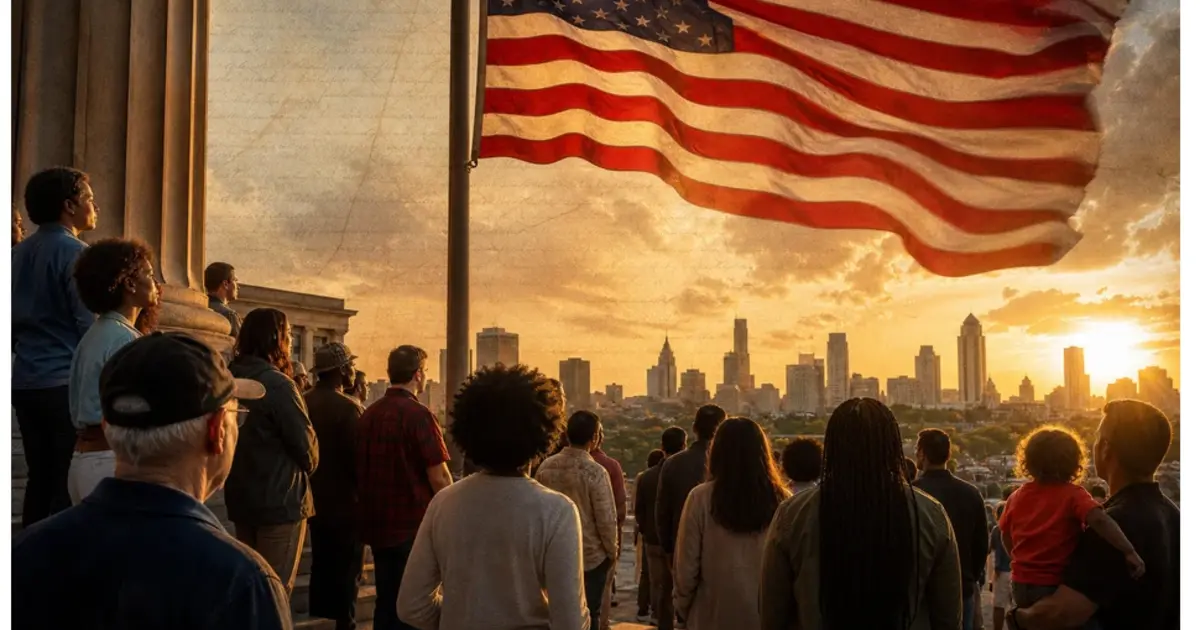
I'm Canadian, so praising America does not come from inherited flag-waving. It comes from proximity.
Canadians live beside the American machine. We mock it, fear it, depend on it, consume it, compare ourselves to it, and quietly measure our own ceiling against it. America is our neighbour, our largest trading partner, our cultural weather system, and the country we most enjoy feeling superior to until we need scale.
That makes America hard to write about honestly.
From Canada, American confidence can look vulgar. The politics look insane. The patriotism can feel theatrical. The individualism often seems excessive. The whole country can feel like someone turned the volume up past what the speakers were designed to handle.
And yet, whenever the world needs capital, military force, software, entertainment, medicine, markets, energy, universities, risk appetite, or sheer productive capacity, everyone still looks south.
That is the contradiction worth thinking about.
On July 4, 2026, the United States marks the 250th anniversary of the Declaration of Independence. Two hundred and fifty years is long enough for a country to reveal its pattern. It is long enough to separate branding from structure. It is long enough to ask why a country so loud, so divided, so internally suspicious, and so full of competing moral visions still manages to produce so much power.
My answer is not that America is harmonious. It is not.
America's real advantage is that it can stomach contradiction without fully seizing up.
The Canadian View
Canada has many virtues. It is safer, calmer, more restrained, and easier to explain at a dinner party. We are good at moderation. We are good at consensus language. We are good at making politics sound administrative rather than existential.
Those are real strengths.
But restraint has a cost. Moderation can become drift. Avoiding conflict can become avoiding decisions. A country can become so proud of being reasonable that it stops asking whether reasonableness is producing anything.
Canada is more orderly. America is more alive.
That is uncomfortable to admit as a Canadian, because much of our identity is built around not being American. We like the idea that we are more sensible. Less extreme. Less arrogant. Less chaotic. Sometimes that is true. Sometimes it is just a polite way of saying we have lower variance.
And variance matters.
A low-variance country has fewer spectacular failures, but often fewer spectacular successes. A high-variance country produces more ugliness, more excess, more ego, more fraud, more noise, and more people saying ridiculous things in public. It also produces more startups, more breakthroughs, more cultural exports, more military readiness, more capital formation, and more people willing to bet their life on an idea before consensus approves.
America is not morally superior because it is powerful. America is powerful because its system allows more variance than almost anywhere else.
Born As An Argument
The United States did not begin as an ethnicity, a monarchy, a church, or a single ancient tribe. It began as a claim.
That claim was simple and explosive: human beings have rights that exist before government, and government only becomes legitimate when it derives power from the consent of the governed.
The obvious criticism is that America did not fully live up to that claim at birth. That criticism is true. The founding generation wrote universal language while tolerating exclusions that were morally indefensible. Slavery existed. Women could not vote. Many people were outside the circle of political equality.
But this is where America's uniqueness starts to show itself. The Declaration did not merely describe what America already was. It created a standard by which America could be judged.
That matters.
A lesser country would have written its founding myth around blood, conquest, language, or divine inheritance. America wrote its founding myth around a principle it had not yet earned. That gap between principle and reality became a source of shame, but also a source of pressure. It gave reformers a weapon. It allowed abolitionists, suffragists, civil rights leaders, immigrants, religious minorities, entrepreneurs, and dissidents to say, in effect: you already promised this. Now live up to it.
That is not hypocrisy in the shallow sense. It is hypocrisy with an escape hatch. It is a civilization that left itself vulnerable to moral correction.
The founding document became a mirror, and America has spent 250 years arguing with its own reflection.
Conflict That Still Produces
The fashionable view is that division is always a sign of decline. Sometimes it is. A society can become so fragmented that it loses the ability to act. It can become so obsessed with symbolic conflict that it forgets how to build. It can mistake grievance for thought and performance for courage.
America is not immune to that. No serious person should pretend otherwise.
A 2024 Gallup poll found that 80% of American adults believed the country was greatly divided on its most important values. An AP-NORC poll ahead of America 250 found that only about a third of the public believed the American Dream still holds true, while many Americans felt conflicted or indifferent about the anniversary itself.
Those are not small warning signs. A country cannot run forever on inherited confidence. The emotional capital of a republic can be spent down like any other form of capital.
But there is another truth sitting beside the pessimism.
America is divided because it contains multitudes. It contains religious conservatives and secular technologists, rural traditionalists and urban progressives, immigrants and old families, libertarians and union households, Wall Street and the military, Hollywood and Texas, Harvard and NASCAR, evangelical churches and AI labs, gun culture and civil liberties lawyers, the richest corporations in the world and people who distrust every institution those corporations touch.
That mixture is volatile.
It is also productive.
A system with no disagreement can be stable, but it is often sterile. A system with too much disagreement can be chaotic, but it can also discover new equilibria faster than more controlled societies. The question is whether the conflict can be metabolized into competition, law, innovation, elections, markets, lawsuits, companies, protests, books, votes, and new institutions.
America's answer, over the long arc, has been yes.
Not always gracefully. Not always fairly. Not always quickly. But often enough, and powerfully enough, to produce the most consequential country in modern history.
The Surface Looks Binary. The Country Is Not.
One of the mistakes outsiders make about America, and that Americans increasingly make about themselves, is believing the television version of the country.
Red versus blue. Left versus right. Coastal elites versus real America. Progressives versus conservatives. Patriots versus traitors. Woke versus anti-woke. Every side has its preferred cartoon.
But real countries are not cartoons. They are portfolios of values.
The 2026 Pew Research Center political typology makes this point well. American politics is deeply divided along partisan lines, but underneath that divide is a more complicated reality: many Americans hold combinations of beliefs that do not fit neatly into either party.
That complexity is important. It means the country is not only two tribes marching toward collision. It is also millions of people holding unstable mixtures of liberty, order, fairness, faith, ambition, compassion, skepticism, tradition, and reinvention.
That instability is frustrating if you want ideological purity. It is valuable if you want adaptation.
A rigid society can be easier to describe. America is hard to describe because it is still processing. It is still sorting. It is still arguing about what its founding words require in each new technological, economic, and moral environment.
That is why America can look insane on Monday and unbeatable by Friday.
Power Is The Output
The numbers are extraordinary.
The World Bank lists U.S. GDP at about $30.77 trillion in 2025, with GDP per capita above $90,000. The Bureau of Economic Analysis reported that real GDP grew at a 2.1% annual rate in the first quarter of 2026. The Stockholm International Peace Research Institute estimated U.S. military expenditure at $954 billion in 2025, still the largest in the world. The National Center for Science and Engineering Statistics estimated U.S. research and development at $937 billion in 2023, with a 2024 estimate approaching $993 billion.
This is not just scale. It is institutional compounding.
Powerful economies do not come from vibes. They come from repeatable advantages: capital formation, property rights, deep markets, universities, energy, immigration, military procurement, entrepreneurial tolerance, bankruptcy law, research networks, cultural ambition, and a general permission structure that lets unusual people try things before consensus approves.
That last part is underrated.
America gives unusual room to the obsessive, the ambitious, the disagreeable, the religious, the anti-religious, the builder, the speculator, the inventor, the protester, and the person who thinks everyone else is wrong. Some of those people fail. Some become annoying. Some become dangerous. But some build companies, movements, technologies, and institutions that change the world.
Freedom creates variance.
Variance creates both ugliness and breakthroughs.
A managed society can reduce the ugliness. It often reduces the breakthroughs too.
America Imports Energy
America's other advantage is absorption.
It absorbs people, capital, culture, anger, talent, religious intensity, intellectual fashion, risk appetite, and foreign ideas. Then it commercializes them, argues about them, constitutionalizes them, turns them into entertainment, builds companies around them, or lets them collide with something else until a new synthesis appears.
That is not always comfortable. Absorption produces friction. Immigration produces real policy questions. Diversity creates real trust problems. Scale makes governance harder. No honest defence of America should require pretending every tension is fake.
But the capacity itself is astonishing.
The U.S. Census Bureau reported that the foreign-born population reached 46.2 million in 2022, up from 40 million in 2010. That is not just a demographic statistic. It is a signal.
People still want into the argument.
They may criticize America. They may worry about America. They may resent American power. But when people choose where to study, build, invest, work, publish, code, raise capital, or reinvent themselves, the United States remains one of the central destinations of human ambition.
That matters because talent is not evenly distributed, and opportunity is not evenly activated. A brilliant person in the wrong system can spend a lifetime pushing against walls. A brilliant person in the right system can become a force multiplier.
America's advantage has never been only that it produces talent internally. Its advantage is that it attracts talent, then places it inside a machine that can turn ambition into output.
That machine is imperfect. But it is real.
The Part Patriots Should Admit
There is a lazy version of American patriotism that deserves criticism.
It treats power as proof of virtue. It confuses military strength with moral cleanliness. It assumes that wealth means wisdom. It hears criticism as betrayal. It wants the benefits of the American system without the burden of self-examination.
That is not patriotism. That is branding.
A serious patriot has to admit that America has problems worthy of a great country. Debt. Institutional distrust. Political violence. Family breakdown. Drug addiction. Censorship pressure. Educational decline. Loneliness. Obesity. Border dysfunction. A politics that too often rewards attention instead of competence.
These are not minor defects. They are not imaginary. Some are severe enough to threaten the compounding machine itself.
But the existence of problems does not settle the question of greatness. It only changes the nature of the claim.
A country can be the best bet in the world and still be in need of repair. In fact, the best country may be the one most capable of repairing itself without needing to destroy itself first.
That is the American test at 250.
Can a free people still self-correct? Can they still argue without dehumanizing? Can they still punish failure, reward competence, build institutions, defend liberty, assimilate newcomers, protect excellence, and pass something better to their children than a list of grievances?
Those are not sentimental questions. They are strategic questions.
Civilizations fail when their feedback loops fail.
America As A Feedback System
This is where America remains structurally brilliant.
Free speech is a feedback loop. Markets are feedback loops. Elections are feedback loops. Federalism is a feedback loop. Independent courts, investigative journalism, shareholder pressure, academic rivalry, religious pluralism, and cultural competition are all feedback loops.
They are messy because feedback is messy.
This is the same basic constraint I wrote about in Vote Like a Capital Allocator, Not a Believer: democracy only works when incentives remain alive.
If a product is bad, customers can leave. If a state is badly governed, people and businesses can move. If a party fails, voters can punish it. If an institution lies, rivals can expose it. If a consensus becomes stupid, dissenters can build around it. If a company misses the future, a startup can attack it. If a law violates the Constitution, someone can challenge it.
That does not mean the system always works. It means the system contains mechanisms for correction.
Authoritarian systems can look more disciplined from the outside because they suppress visible disagreement. But suppressed disagreement does not disappear. It becomes hidden error. It moves upward through falsified incentives until reality finally breaks the illusion.
America, by contrast, often looks worse than it is because it processes so much of its conflict in public.
The argument is visible. The contradictions are visible. The failures are visible. The hypocrisy is visible. The absurdity is visible.
That visibility can be embarrassing.
It is also one reason the country keeps adapting.
Why I Still Bet On America
So is America the best country in the world?
I think yes, but not in the shallow way people usually mean it.
Not because every American policy is wise. Not because every American citizen is free in the same lived way. Not because America has avoided cruelty, stupidity, corruption, or arrogance. It has not.
America is still the best bet because it combines scale, liberty, ambition, self-correction, institutional depth, technological imagination, military deterrence, immigrant energy, capital markets, and moral language in a way no other country has matched.
It is the country where contradiction has been made productive.
It is the country where a person can arrive from somewhere else and become fully part of the national story. It is the country where the government can be distrusted out loud. It is the country where the flag can be waved, burned, worn, saluted, commercialized, fought over, and still somehow remain powerful. It is the country that can generate both fierce individualism and enormous collective mobilization. It is the country that can spend decades arguing about its identity while continuing to shape the future everyone else has to respond to.
That is not normal.
That is historically bizarre.
And it is precious.
The Job At 250
A 250th anniversary should not be treated like a decorative event. It should be treated like an audit.
What has been inherited? What has been wasted? What still works? What has become performative? What needs defending? What needs reforming? What must be rebuilt before it breaks?
The danger of patriotism is nostalgia. The danger of criticism is ingratitude. America needs neither as a governing philosophy.
It needs a mature patriotism.
A mature patriotism can say the founding was magnificent without pretending the founding was complete. It can honor soldiers without worshipping war. It can defend borders without hating foreigners. It can celebrate markets without ignoring families and communities. It can protect speech even when speech is ugly. It can love equality without flattening excellence. It can welcome disagreement without turning politics into permanent civil war.
That is difficult. But difficulty is not evidence against the American project. Difficulty is the project.
America at 250 should not ask citizens to pretend the country is harmonious. It should ask whether the argument is still worthy of them.
I think it is.
I don't love America the way an American loves America. I respect it the way a Canadian who understands incentives has to respect it: reluctantly at times, critically always, but seriously.
Because for all its noise, ego, excess, and contradiction, America still does something rare. It converts freedom into motion.